In high rise structural design, the dead weight of the building is one of the primary drivers of material cost. The self weight of partition walls, external infill walls, and structural slabs constitutes the majority of the gravitational loads that columns, shear walls, and foundations must support. Traditional clay brick masonry, with its high density and thick mortar joints, adds massive dead load to structures, requiring larger concrete volumes and heavier steel reinforcement configurations.
By replacing clay bricks with Autoclaved Aerated Concrete (AAC) blocks, structural engineers can significantly decrease dead loads, creating a cascading savings effect throughout the RCC frame. This case study analyzes the quantitative material and financial savings achieved by switching to AAC blocks in a standard 20-story commercial building project.
1. Physical Parameter Comparison
The core mechanism behind AAC's structural advantage is its exceptionally low density compared to traditional masonry options. Below is the density and thermal parameter comparison table:
| Material Properties | Traditional Clay Bricks | Solid Concrete Blocks | Balaji AAC Blocks |
|---|---|---|---|
| Dry Bulk Density (kg/m³) | 1,700 - 1,900 | 2,200 - 2,400 | 550 - 650 |
| Compressive Strength (N/mm²) | 3.5 - 5.0 | 5.0 - 7.5 | 3.0 - 4.5 |
| Thermal Conductivity (W/m·K) | 0.81 - 0.90 | 1.25 - 1.40 | 0.12 - 0.16 |
| Standard Dimensions (mm) | 230 x 110 x 75 | 390 x 190 x 190 | 600 x 200 x (100 to 300) |
| Fire Resistance Rating | 1 - 2 Hours | 2 Hours | Up to 4 Hours |
As shown, AAC blocks are approximately one third the weight of clay bricks and one fourth the weight of concrete blocks. This density difference is the source of all structural dead load reductions.
2. Dead Load Reduction Analysis
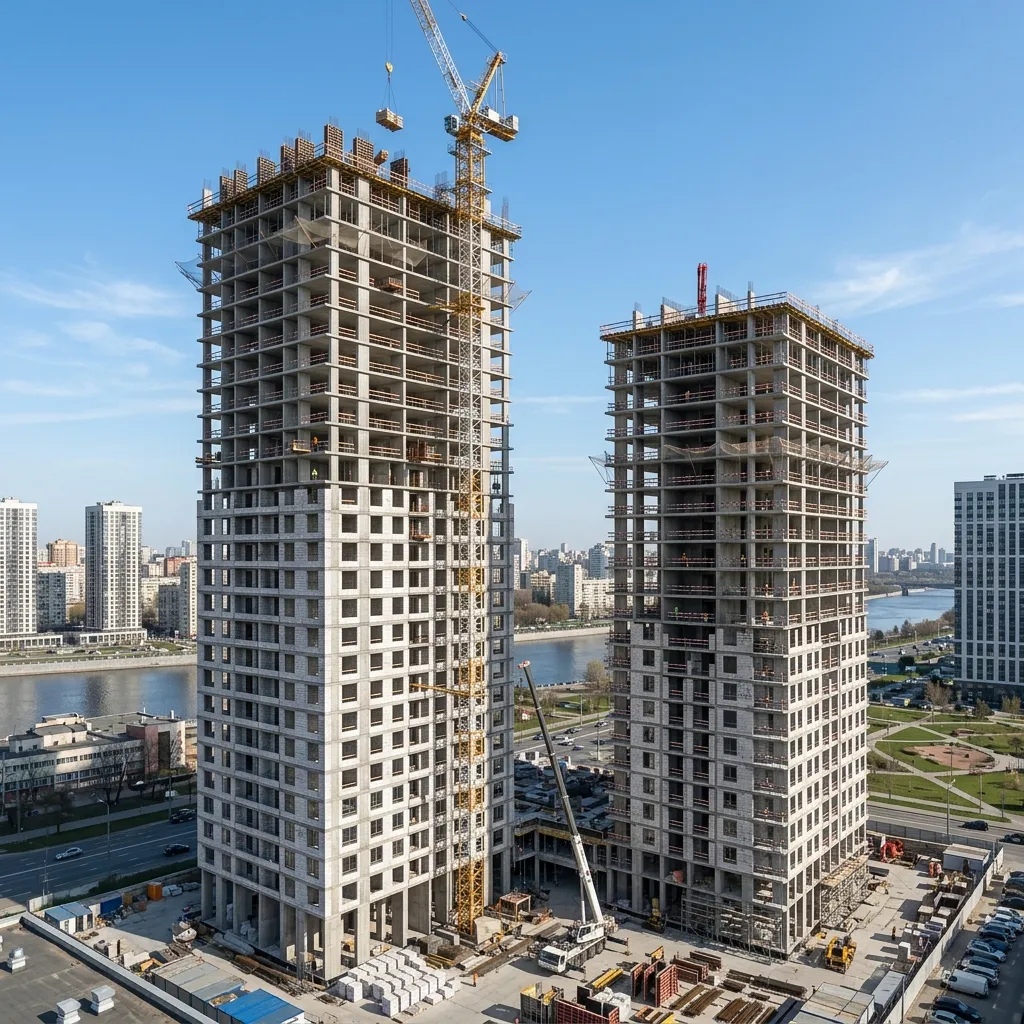
Let us consider a standard 20-story B2B commercial high rise building with a floor area of 1,500 m² per floor. The building has a total masonry wall area of approximately 2,000 m² per floor (including 200mm external walls and 100mm internal partitions).
To calculate the gravitational dead load (\(P_{dead}\)) exerted by the masonry walls, we use the density of the masonry assembly:
Scenario A: Traditional Clay Bricks
- Density of Clay Brick: 1,800 kg/m³
- Density of 12mm Sand Cement Mortar: 2,000 kg/m³
- Composite Assembly Weight (including plaster): ~2,100 kg/m³
- Total Wall Dead Load per Floor: 2,000 m² × 0.15m (average thickness) × 2,100 kg/m³ = 630 Metric Tons (MT)
- Total Building Wall Load (20 Floors): 12,600 MT
Scenario B: Balaji AAC Blocks
- Density of AAC Block: 600 kg/m³
- Density of 2mm Thin Bed Mortar: Negligible due to thin volume.
- Composite Assembly Weight (including lightweight plaster): ~750 kg/m³
- Total Wall Dead Load per Floor: 2,000 m² × 0.15m (average thickness) × 750 kg/m³ = 225 Metric Tons (MT)
- Total Building Wall Load (20 Floors): 4,500 MT
Dead Load Savings: By switching to AAC, the total weight of the masonry walls decreases from 12,600 MT to 4,500 MT. This represents a net dead load reduction of 8,100 Metric Tons, or approximately a 30% reduction in the total dead weight of the high rise structure.
3. RCC Structural Savings (Steel and Concrete)
Because the vertical load on columns and shear walls is reduced by 8,100 MT, structural engineers can redesign the concrete columns, beams, and foundations to handle smaller gravity loads. This redesign leads to substantial material savings:
Steel Rebar Savings (15% to 20%)
In high rise buildings, column steel configuration is determined by axial loads and bending moments. A 30% reduction in wall dead load translates directly to lower axial loads at the base of the columns. B2B engineering calculations show that reinforcement steel (rebar configurations) in columns and beams is reduced by 15% to 20%. This reduces both the tonnage of steel required and column sizes (e.g., from 600mm x 600mm to 500mm x 500mm), freeing up usable carpet area on every floor.
Foundation Volume Savings (10% to 15%)
The reduction in vertical loads reduces the bearing pressure on the foundation. For pile foundations, the total number of piles or pile depths can be reduced. For raft foundations, the thickness of the concrete slab is reduced, resulting in 10% to 15% savings in concrete volume and excavation costs.
4. Thermal Insulation & HVAC Load Reductions
In addition to structural savings, the low thermal conductivity of AAC blocks ($k = 0.12 - 0.16 \text{ W/m}\cdot\text{K}$) compared to clay bricks ($k = 0.81 \text{ W/m}\cdot\text{K}$) dramatically lowers the heat transmission coefficient (U value) of the building envelope:
With a U value that is nearly 70% lower, AAC walls block external heat from entering the building during summers and retain cooling inside. For a 20-story commercial office block, this thermal barrier reduces the cooling thermal load on central chiller plants by 25% to 30%. This provides immediate B2B capital savings by reducing the required HVAC chiller tonnage, and ongoing operational savings on electricity bills.
5. Speed of Construction & Project Timelines
Financing costs represent a significant expense in real estate development. Accelerating the construction schedule lowers interest expenses and allows for faster tenant leasing:
- Lay Rate: A standard AAC block (600mm x 200mm x 200mm) is equivalent in volume to 9 standard clay bricks. A bricklayer can lay 1 block in the time it takes to place 2 clay bricks, increasing masonry speeds by up to 300%.
- Mortar Savings: Because thin bed mortar uses 80% less wet mixture than traditional mortar, the time spent preparing and hoisting mortar is drastically reduced.
- Plastering: The precise flatness of AAC walls eliminates the need for thick rough plastering. A thin 3-5mm layer of gypsum plaster is sufficient, reducing curing and drying wait times.
| Material Cost & Resource Comparison | Clay Brick Masonry | Balaji AAC Block Masonry |
|---|---|---|
| Tonnage of Masonry Steel Required (RCC) | 100% (Baseline) | 83% (17% Net Savings) |
| Masonry Concrete Volume (RCC) | 100% (Baseline) | 88% (12% Net Savings) |
| Plastering Thickness Required | 15 mm - 20 mm | 3 mm - 5 mm |
| Masonry Labor Cost (Per m²) | ₹180 / m² | ₹80 / m² (55% Savings) |
| Overall Project Speed | Baseline | 30% Faster Completion |
6. Case Study Conclusion
For a 20-story building project, switching from traditional clay bricks to Balaji AAC blocks reduces construction costs by approximately ₹120 to ₹160 per square foot of built up area. When combined with utility savings from smaller HVAC configurations and reduced interest expenses due to a 3-month reduction in the construction timeline, the return on investment (ROI) is highly favorable for developers.
For developers, architects, and structural designers, AAC is not just a material choice; it is a comprehensive structural optimization strategy that improves both building performance and project profitability.
B2B Turnkey Setup Solutions Across Maharashtra & India
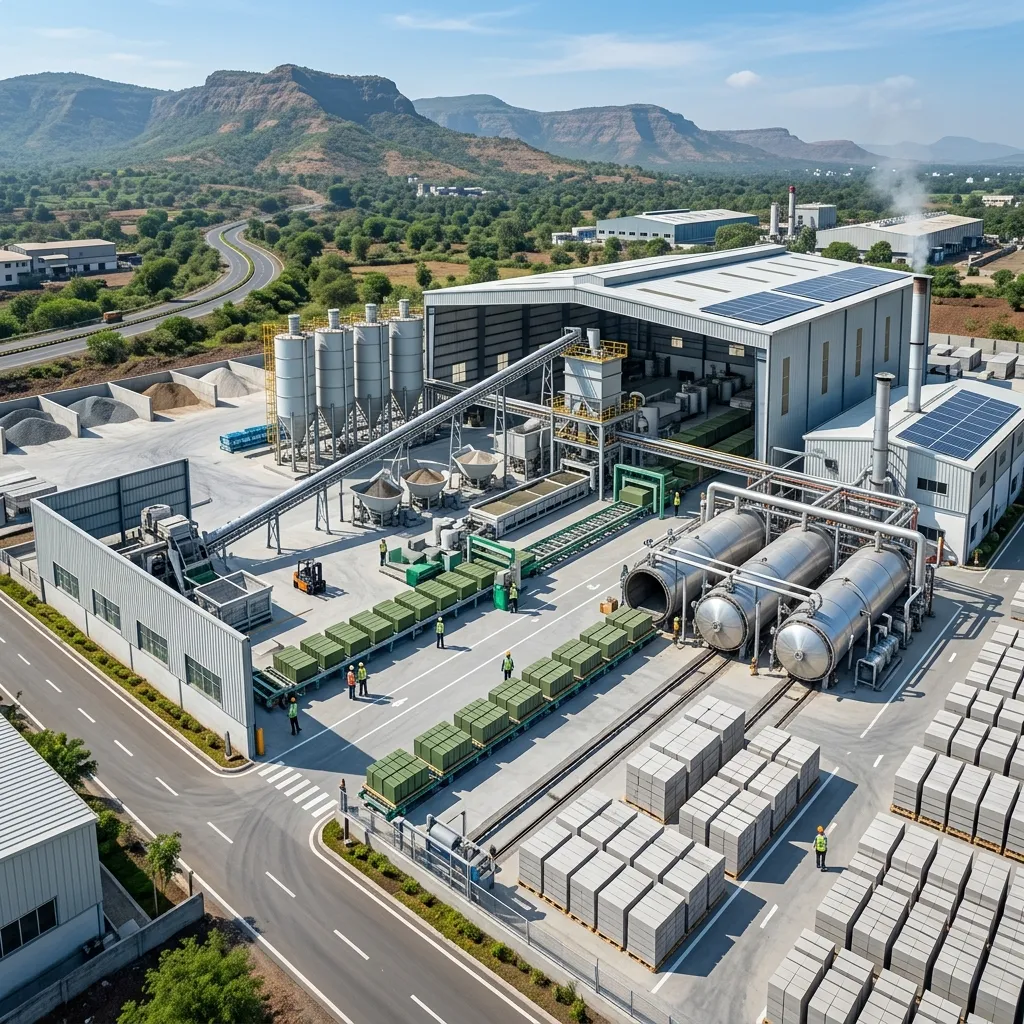
As a leading engineering company based in Satara, Maharashtra, Balaji Construction Machines and Spares delivers automated autoclaved aerated concrete manufacturing plants nationwide. We specialize in layout engineering, site commissioning, and operator training for customers in major industrial zones around Mumbai, Pune, Nagpur, Nashik, and Aurangabad.
Our installation reach covers key construction markets across Indian states like Gujarat, Madhya Pradesh, Karnataka, Telangana, Andhra Pradesh, and Tamil Nadu. Whether you are running a setup cost estimation for a new factory, looking up detailed machinery specifications, or interested in starting a sustainable B2B business, we provide complete engineering support. Contact our sales team to schedule a technical consultation at your site.